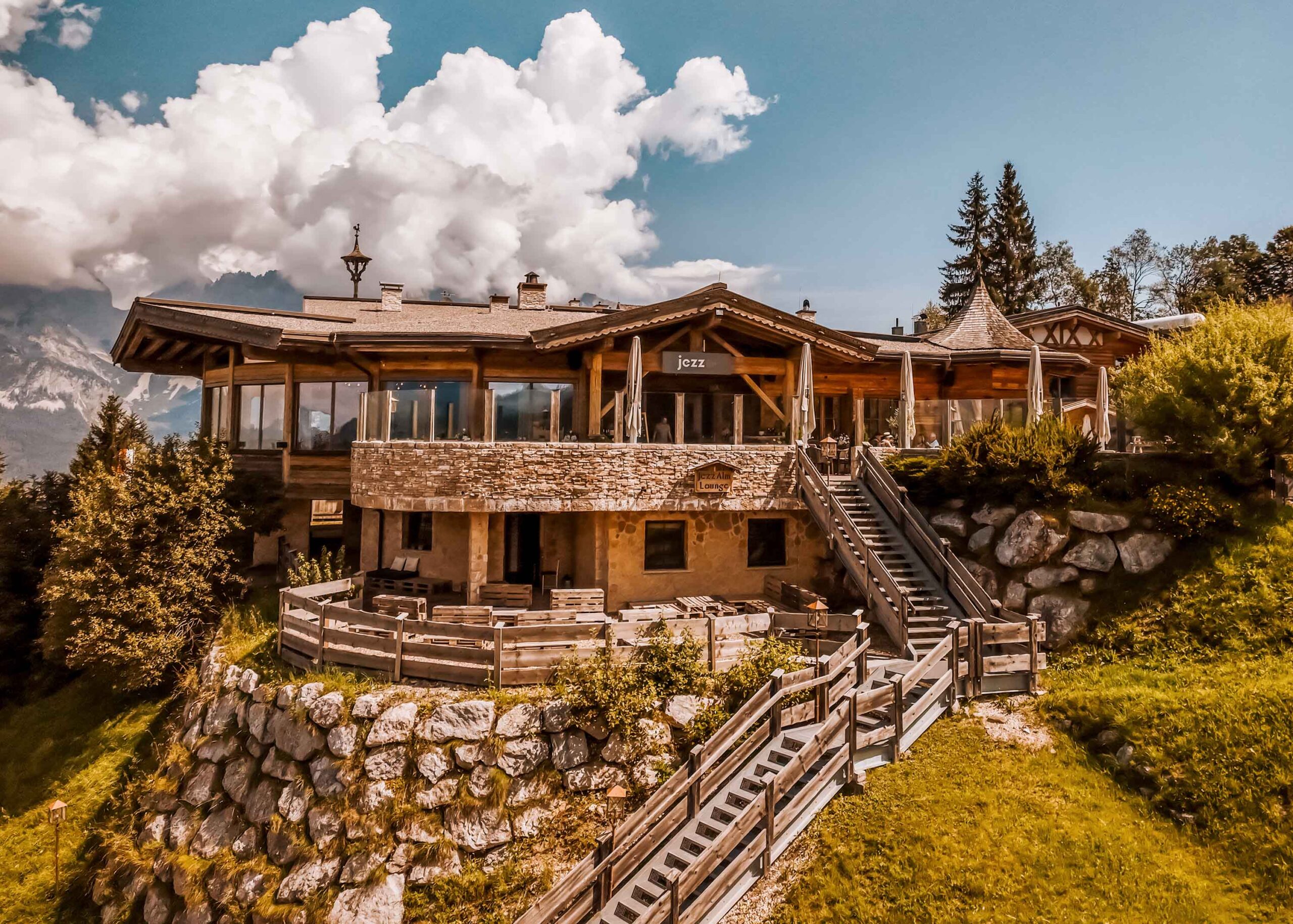


Many wedding couples wonder if with 150 guests they really get married in the mountains can. Doubts often exist, whether a suitable Wedding location, that a sufficient number of rooms and well-organized paths for a large party are compatible with each other. This Real Wedding shows that a large Mountain wedding in Austria is easily feasible if the crucial points are brought together early on.
For this Destination Wedding guests traveled from the USA, Great Britain, Austria and other countries into Salzburger Land. Therefore, it was clear from the beginning that not just the wedding day, but a complete wedding weekend should be planned. The Schwarzacher provided the setting for the symbolic wedding ceremony, the dinner, and the celebration. The Unterschwarzachhof was used as a hotel and venue for the get-together.
In my work as a wedding planner I experience regularly that a international wedding clear communication, proactive guest management, and flexible solutions on-site are required. How this was implemented at this wedding and what insights other couples can take away from it, I will show in this post.
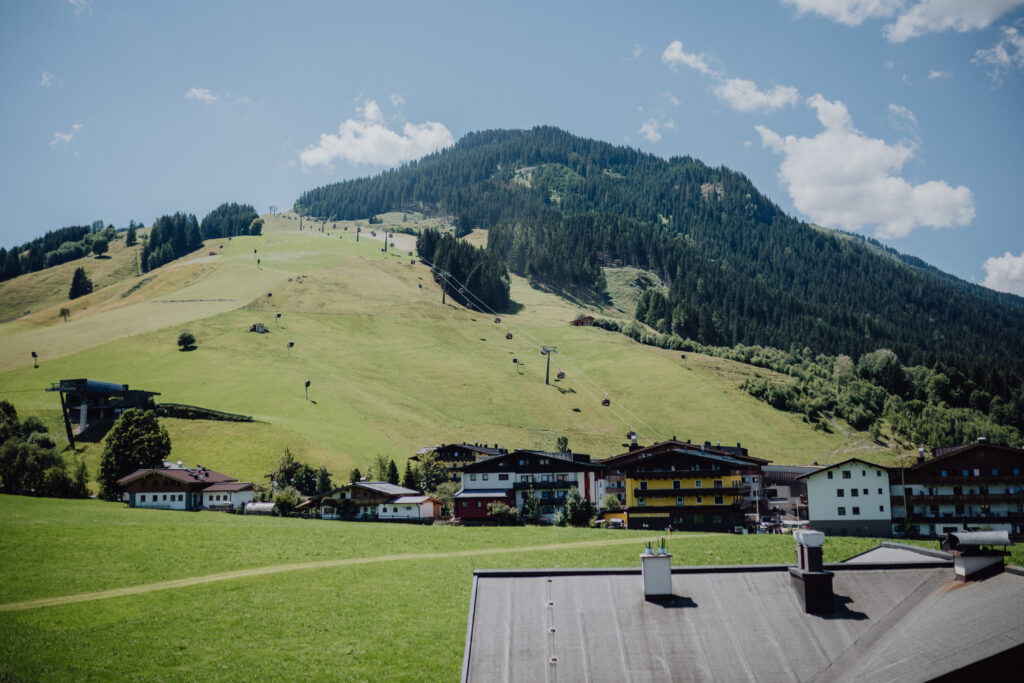
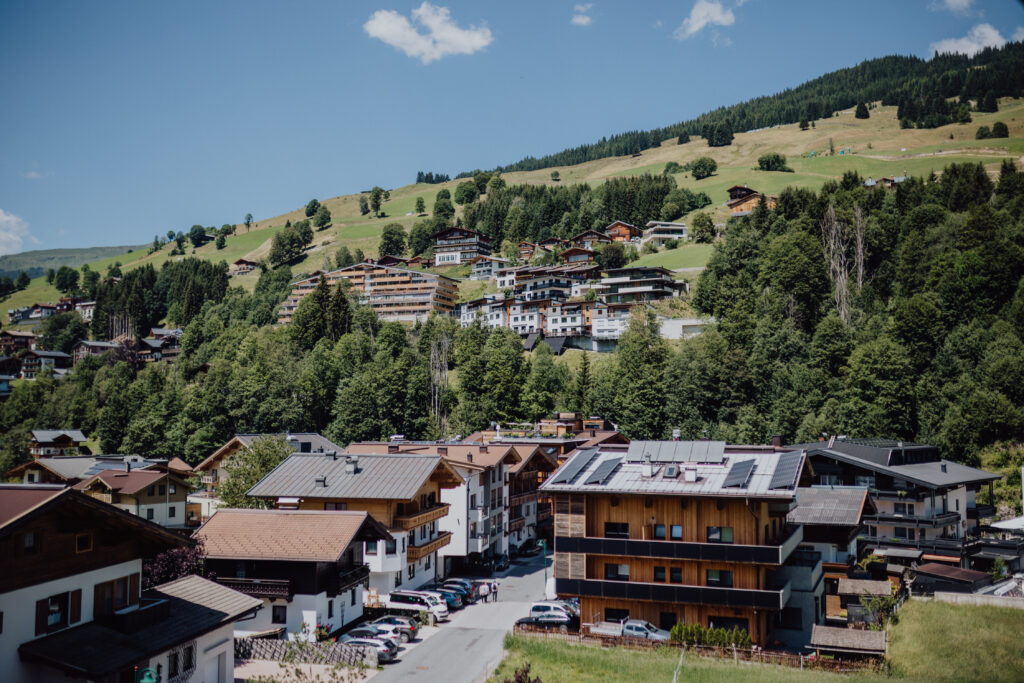
Destination Wedding in Austria: Why the Salzburger Land Was Chosen
The decision for a Destination Wedding in Austria was closely connected to the personal roots of the bridal couple. At the same time, the region had to suit an international guest list, a large celebration, and a multi-day wedding concept.
Nature and mountains instead of a wedding in the city
The bridal couple lives in London, but consciously wanted to get away from the urban environment for their wedding. Vienna was therefore also out of the question. What they wanted were mountains, meadows, and a setting where the celebration wasn't limited to a single event day.
The Salzburger Land combined these wishes with a usable infrastructure. Who get married in the mountains would like, should nevertheless not only pay attention to the surroundings when choosing the region. Equally important are reliable accessibility, suitable accommodations, and enough space for the planned itinerary.
The decoration was also adapted to the surroundings. Instead of elaborate setups, the bride and groom opted for a minimalist design. The mountain landscape was supposed to remain visible and not be pushed into the background by too many individual elements. This created a clear concept that suited the wedding venue and the schedule of the weekend.
International guests and Austro-American influences
The guests traveled from the USA, Great Britain, Austria, and other countries. The groom has Austrian roots, while the couple lives together in London. For the international wedding therefore, a sequence was important that combined various influences without appearing contrived.
Austrian elements appeared in the regional cuisine, the choice of the mountain region, and a folk dance workshop in the evening. At the same time, American-influenced program items such as the rehearsal on Thursday were part of the wedding weekend. The connection did not come about through a fixed motto, but rather through personal choices related to the bridal couple and their families.
With a Destination Wedding with guests who have traveled from afar, such a mix can work very well. The important thing is not just to include traditions as a scheduled item, but to give them a logical place in the flow of events.
16 months of planning for a large mountain wedding
The first inquiry was made in February 2025, about 16 months before the wedding in July 2026. A total of 175 guests were invited, and about 150 attended the Mountain wedding part. Because of this, the wedding venue, hotel, service providers, travel arrangements, and multi-day program had to be coordinated with one another well in advance.
My experience as a wedding planner shows, that for a large wedding, the guest count alone does not determine the planning effort. Equally relevant are international travel connections, various arrival times, multiple events, and the routes between the hotel, the ceremony, and the supporting program.
Through the comprehensive planning, the rehearsal, the get-together, the wedding day, and the joint wrap-up on Sunday could be planned as a cohesive weekend. The long lead time provided enough space to make well-founded decisions and to take special requirements into account in a timely manner.
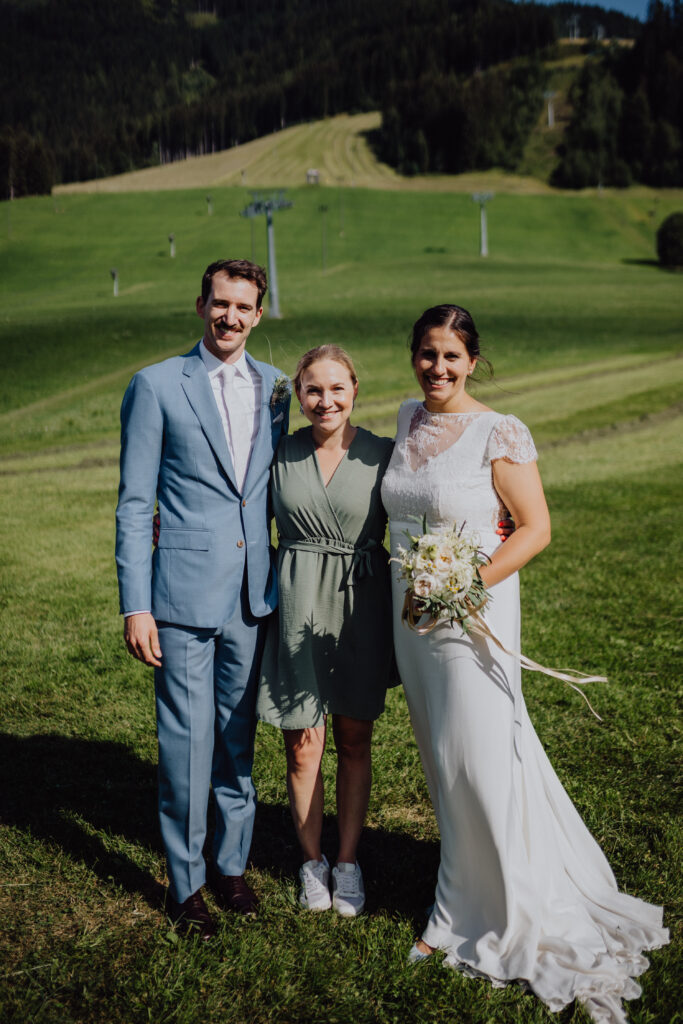
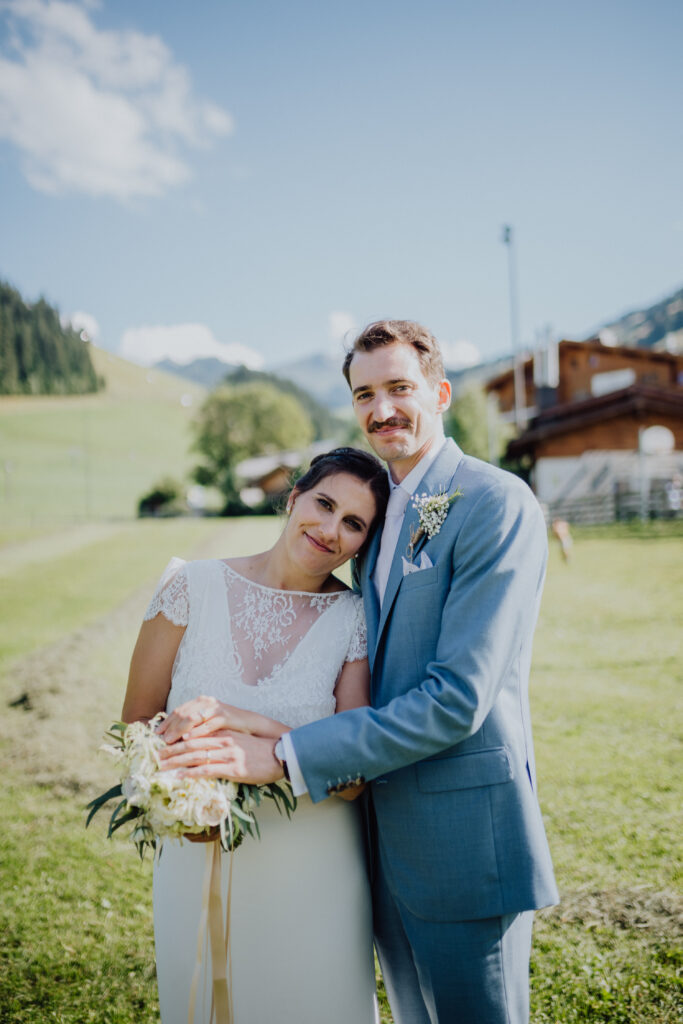
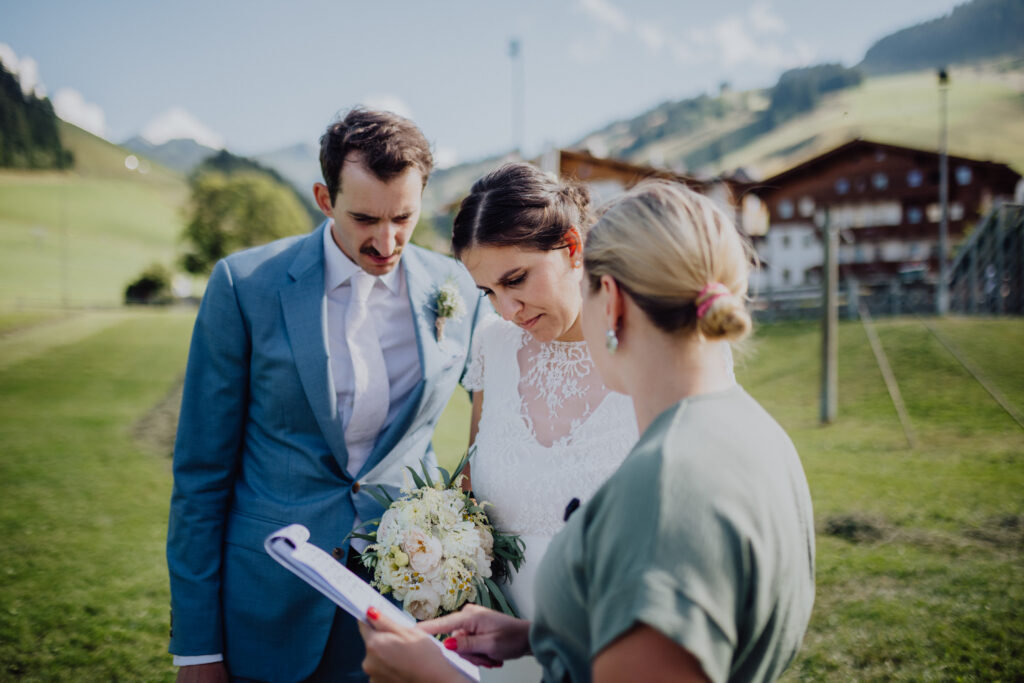
Mountain wedding at the Schwarzacher with 150 guests
For the big one Mountain wedding a wedding venue was needed that sufficient space for a free wedding ceremony, dinner and party boat. The Schwarzacher fulfilled these requirements, while the exclusively booked Unterschwarzachhof took care of the accommodation for the wedding party.
Why the Schwarzacher was suitable as a wedding venue
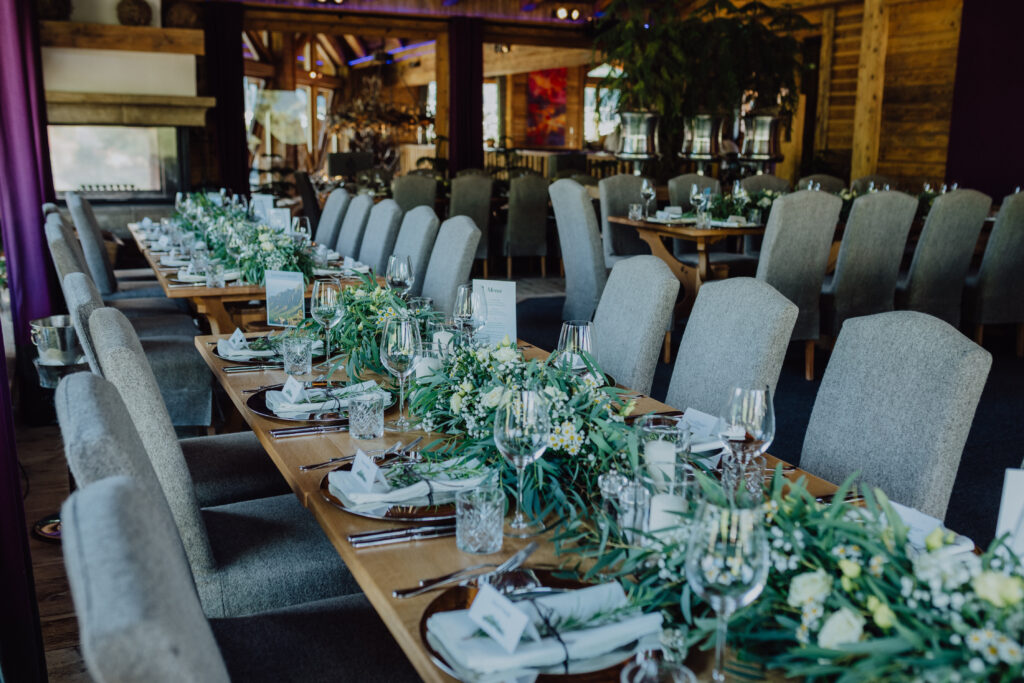
For the Destination Wedding a wedding venue was sought that could accommodate around 150 guests while still allowing for an intimate setting. The Schwarzacher offered space for the symbolic wedding ceremony on the lawn, the reception on the terrace, the dinner, and the subsequent party.
At this scale, the processes of the service providers must also be taken into account. Location team, Floristry, Photography, DJ, Musician, confectionery and catering require fixed setup times, suitable access routes, and clear points of contact. Therefore, the individual areas were coordinated with one another at an early stage.
As a wedding planner For a large international wedding, I don't just check the capacity of a venue. Equally important are logistics, time frames, technical requirements, and on-site responsibilities. Having enough space alone is not enough if setup, guest arrivals, and the program schedule don't reliably mesh together later on.
Combining a hotel and wedding venue in a meaningful way
The Unterschwarzachhof was booked exclusively for the wedding party. This gave the guests a common starting point throughout the weekend. Especially for guests from different countries, a centrally organized hotel makes orientation much easier.
The get-together on Friday took place right at the Unterschwarzachhof. On Saturday, the bridal couple and many guests prepared there for the wedding ceremony and the celebration at the Schwarzacher. After the party, the rooms were accessible without complex late-night transfer planning.
Short and clearly communicated channels also help the hotel team, catering, and other service providers. Anyone with many guests get married in the mountains wishes, should therefore not only check the event rooms. Room capacities, breakfast times, check-in procedures, deliveries, transfers, and possible quiet areas are also part of selecting the hotel and Wedding location.
Sustainable travel with public transport
Since many guests came from abroad, good accessibility without a private car was an important factor. Not everyone should need to rent a car for the wedding weekend. Therefore, train and bus connections were already checked during the planning stage and communicated via the wedding website.
Guests received information there on how to get to the Unterschwarzachhof, suitable connections, and the use of public transport in Salzburger Land. The mobility services available to hotel guests were also explained. This made it possible to complete many journeys within the region without the need for additional car trips.
With a Destination Wedding in Austria centralized communication is particularly helpful. International guests usually do not know distances, transfer options, and regional connections. Clear instructions reduce uncertainties and individual inquiries. For trips that are not possible by bus or train, reliable transport service providers or alternatives should still be planned early on.
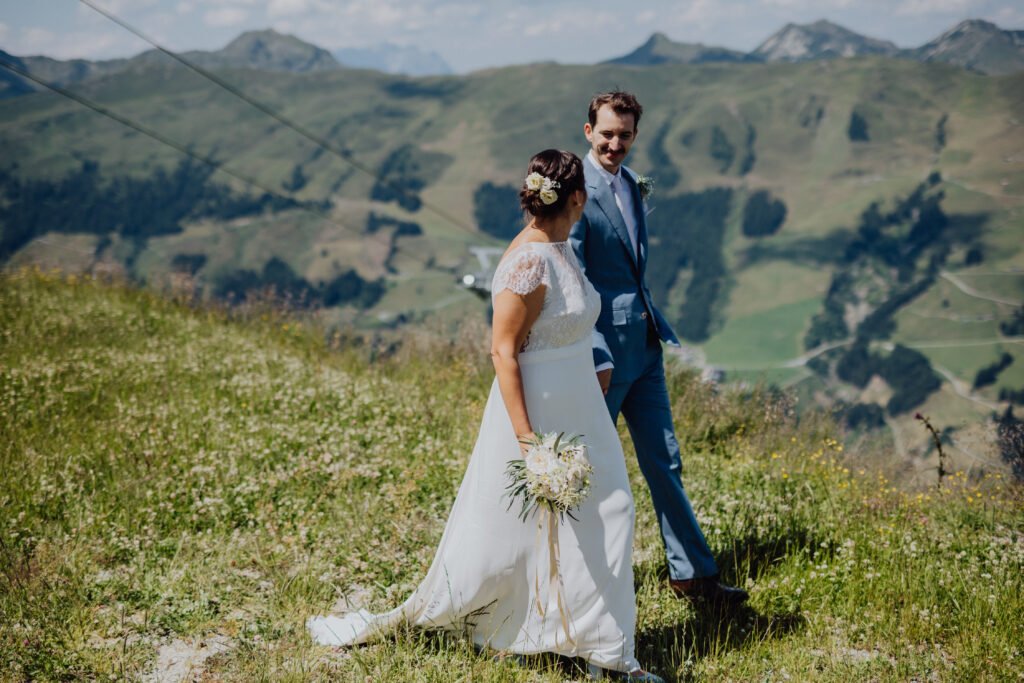
Wedding weekend at a destination wedding with international guests
With a Destination Wedding with guests who have traveled from afar, a single wedding day is often too short. A multi-day schedule creates more shared time and takes the pressure off Saturday. The joint program therefore already began on Thursday.
Rehearsal as a joint kickoff
On Thursday, a rehearsal took place, as is common at American weddings. During this, the most important procedures were run through together in advance. This was especially helpful because friends and selected guests would later be actively involved in the secular wedding ceremony.
A rehearsal does not have to be a full run-through of the wedding day. Often, it is enough to go over entrances, positions, musical cues, speeches, and special rituals. Musicians, the venue team, and other service providers involved also benefit from clear agreements.
Such preliminary appointments give the people involved security and reduce follow-up questions on the wedding day. With a large Mountain wedding is particularly valuable because many processes take place in parallel. At the same time, Thursday was deliberately kept quiet and did not feel like an additional official wedding day.
Get-together with 135 guests at the Unterschwarzachhof
On Friday, most of the guests arrived. At 7 p.m., the get-together began with around 135 people in the Unterschwarzachhof. The evening was planned casually. There were snacks and regional dishes on the tables, including Pinzgauer Bladln. Short speeches and plenty of time for conversation completed the schedule.
Clear organization was still necessary for the catering and hotel team. With more than a hundred guests, seating arrangements, beverages, service times, and special dietary requirements must be coordinated. A casual evening still requires reliable structures in the background.
The regional cuisine fit the decision to celebrate in Austria, without turning it into a rigid motto. International guests were able to get to know typical dishes and at the same time arrive and settle in calmly after their journey.
Why an evening together before the wedding makes sense
At a wedding with 150 guests, the couple can hardly have longer conversations with every person on Saturday. A get-together therefore takes a lot of pressure off the actual wedding day. Guests already get to know each other, families and circles of friends start talking to one another, and international groups find it easier to connect.
The wedding couple can also consciously greet individual guests. The next day, the celebration begins with a greater sense of familiarity because many first meetings have already taken place. Especially in the case of long travel distances, a shared evening feels appreciative, without needing to turn into a second wedding day.
Based on my many years of experience in wedding planning this part of the program is often particularly helpful at a large destination wedding. Good food, a clear schedule, and enough space for conversation are usually enough. The evening does not need to be overloaded with additional program items.
The Wedding Day at the Schwarzacher: Flow of a Destination Wedding with 150 Guests
Saturday was planned so that the preparation, free wedding ceremony, reception, dinner, and party flowed seamlessly into one another without unnecessary waiting times. With around 150 guests, including 15 children, the hotel, wedding venue, gondola ride, and service providers had to be closely coordinated.
Getting Ready at the Unterschwarzachhof and Setup at the Schwarzacher
The day began for the guests from 8:30 a.m. with breakfast in the Unterschwarzachhof. Preparations were already underway in the suites in parallel. The styling of the bridal couple and selected relatives took place at the hotel. Later, photography for the getting-ready shots was added.
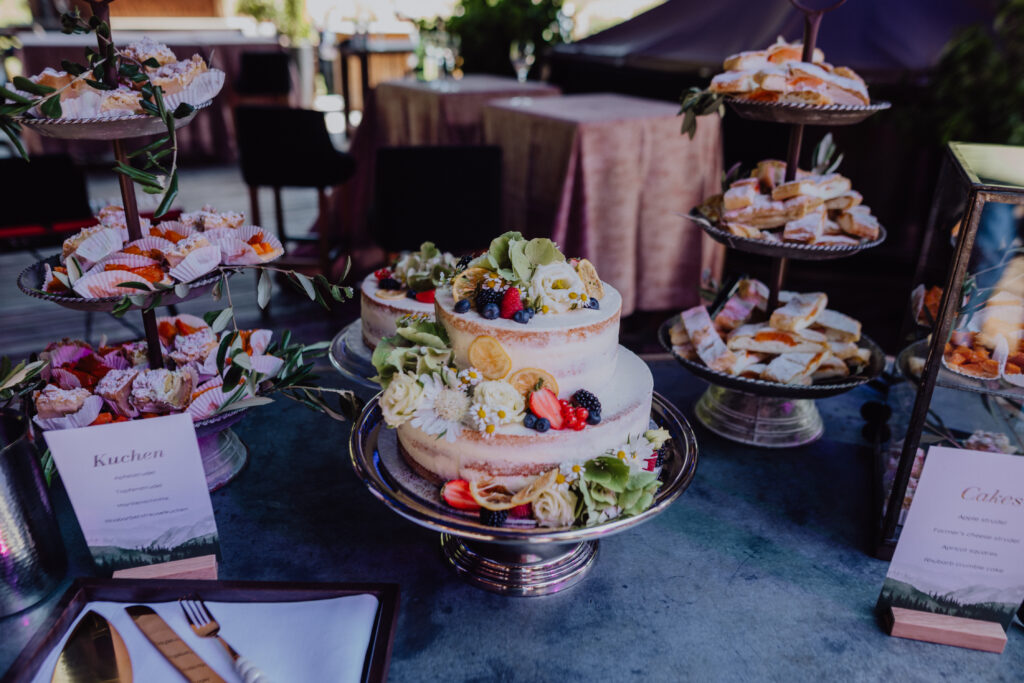
Meanwhile, in the Schwarzacher the setup for the wedding ceremony and the subsequent reception. The florists prepared the Chuppa and further elements. Wedding cake and desserts were delivered, the musicians arrived in the early afternoon and tested the technology for the livestream.
At a large Mountain wedding Before the wedding ceremony, many tasks happen simultaneously. A precise schedule therefore helps the bridal couple, the hotel team, the venue team, and all service providers. Deliveries, setup times, and contact persons should be clearly defined so that preparations at different locations do not interfere with each other.

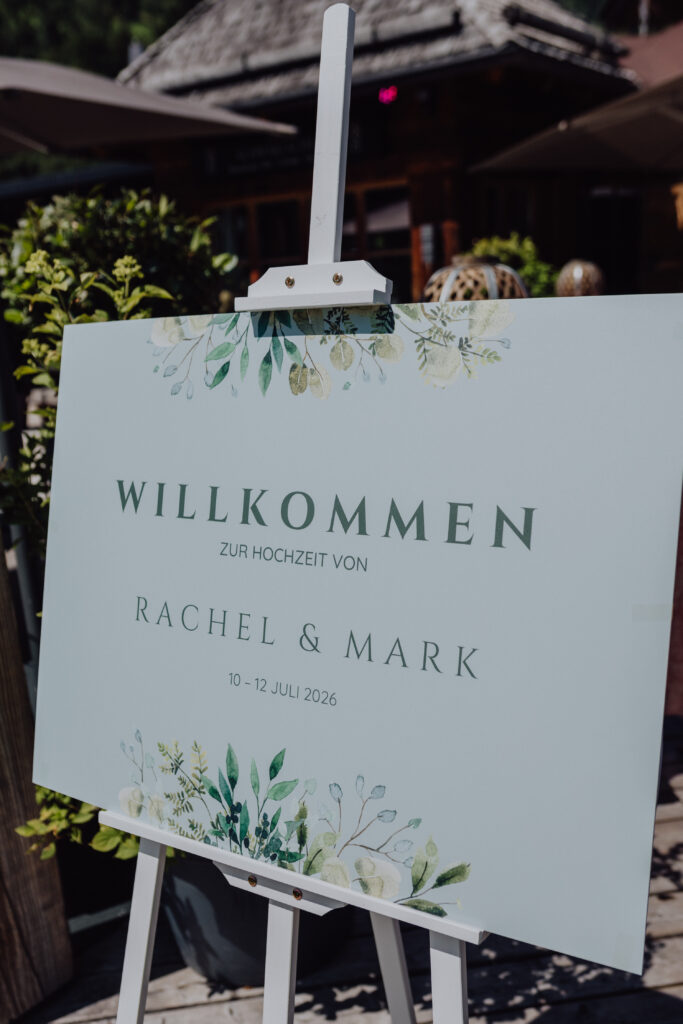

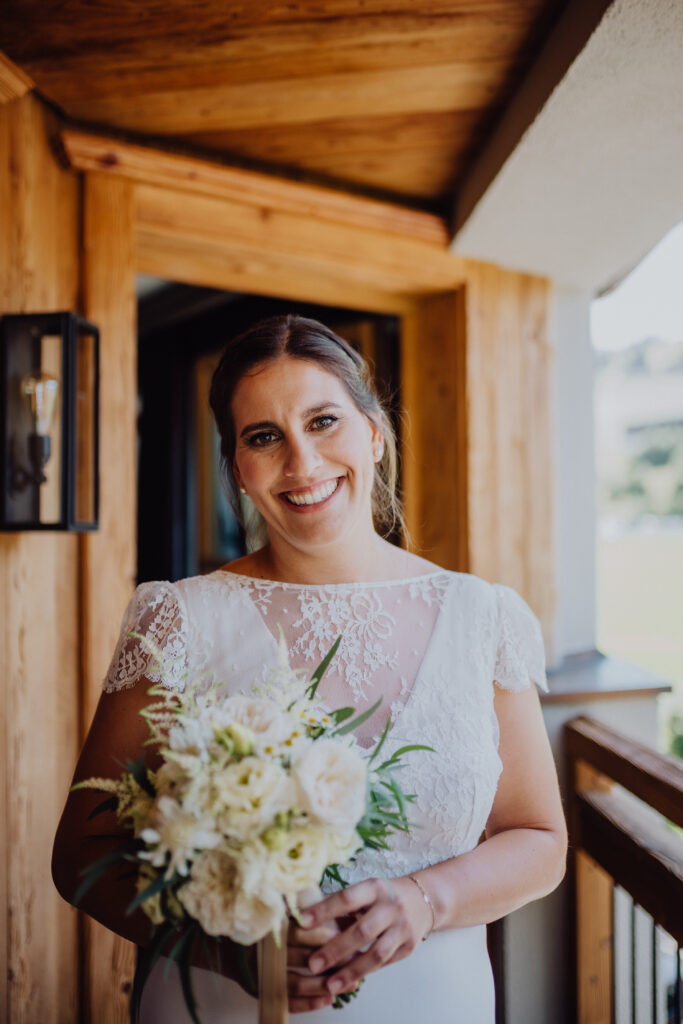
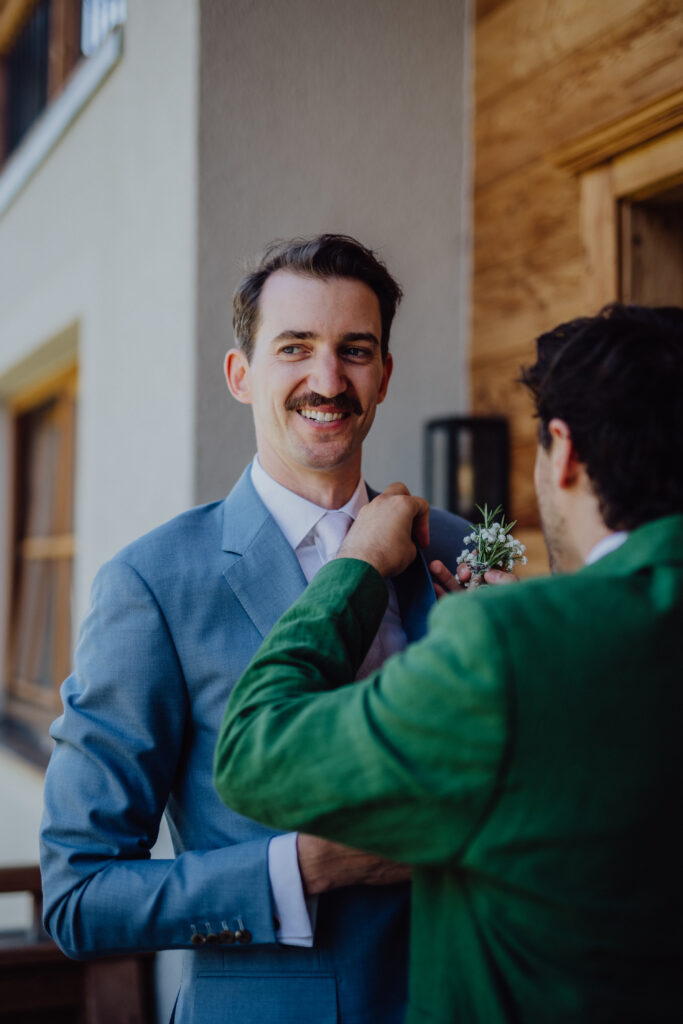
First look on the mountain and arrival of the guests
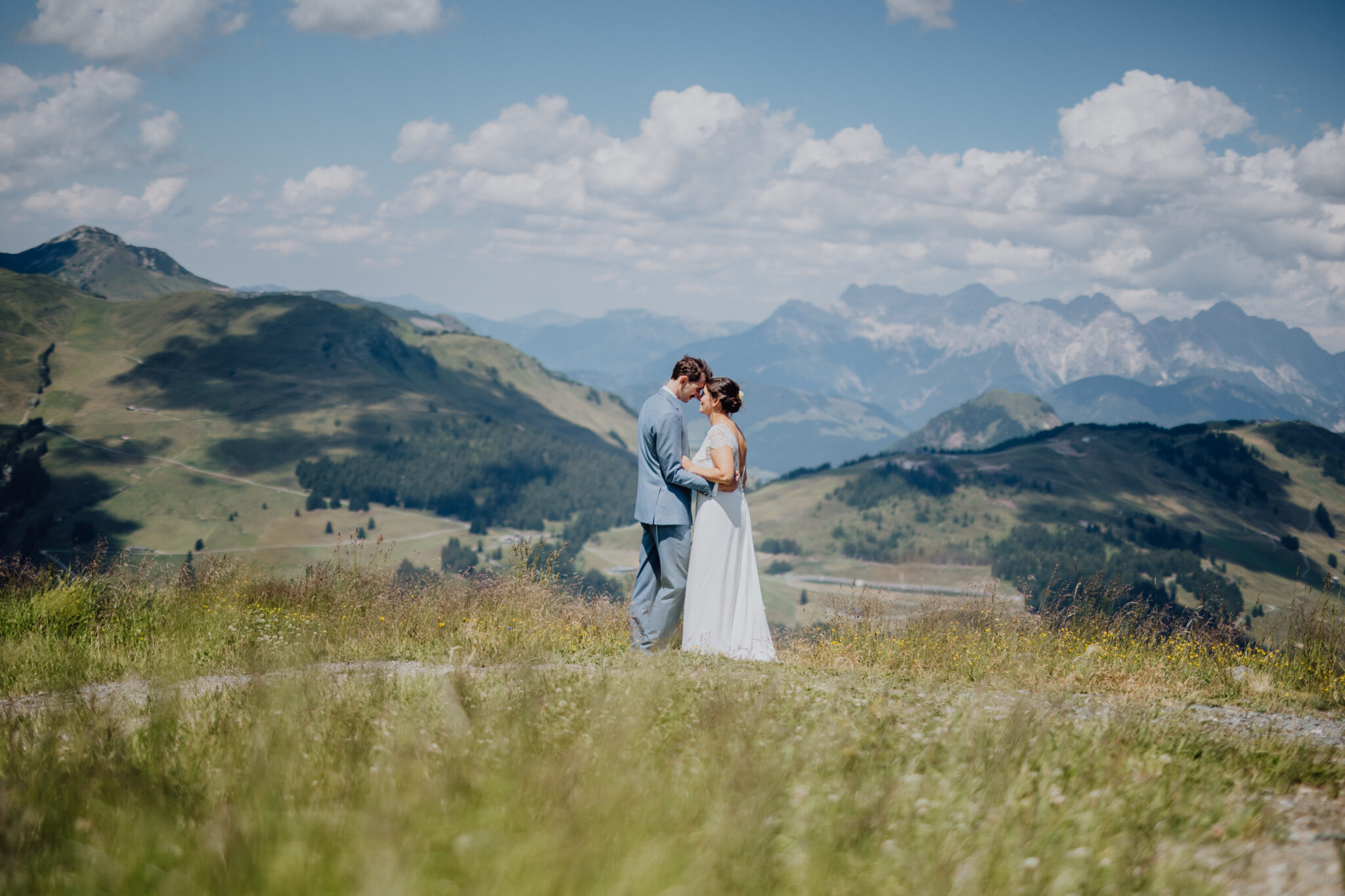
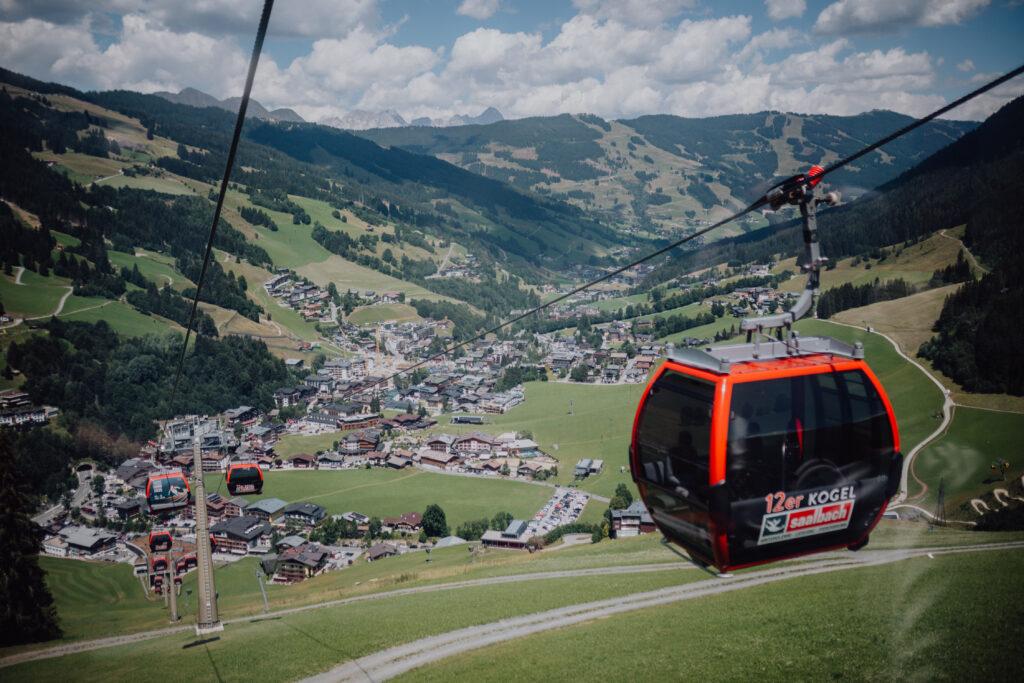
Around 2 p.m., the bridal couple took the Westgipfelbahn up the mountain. The first look and the subsequent photos took place at the middle or top station, depending on the conditions. This left sufficient time for photography without delaying the later schedule.
After the descent around 2:40 p.m., the groom returned directly to the Schwarzacher. The bride was first taken discreetly to the Unterschwarzachhof and then accompanied separately to the wedding venue. Due to the bike festival taking place at the same time, this route had to be adjusted at short notice.
From 3 PM, guests arrived at the Schwarzach. Before the wedding ceremony, non-alcoholic drinks, water, and initial finger food were offered. This brief reception made sense given the summer temperatures and prevented an unsettled waiting period between arrival and the ceremony.
Free wedding ceremony on the meadow of the Schwarzacher
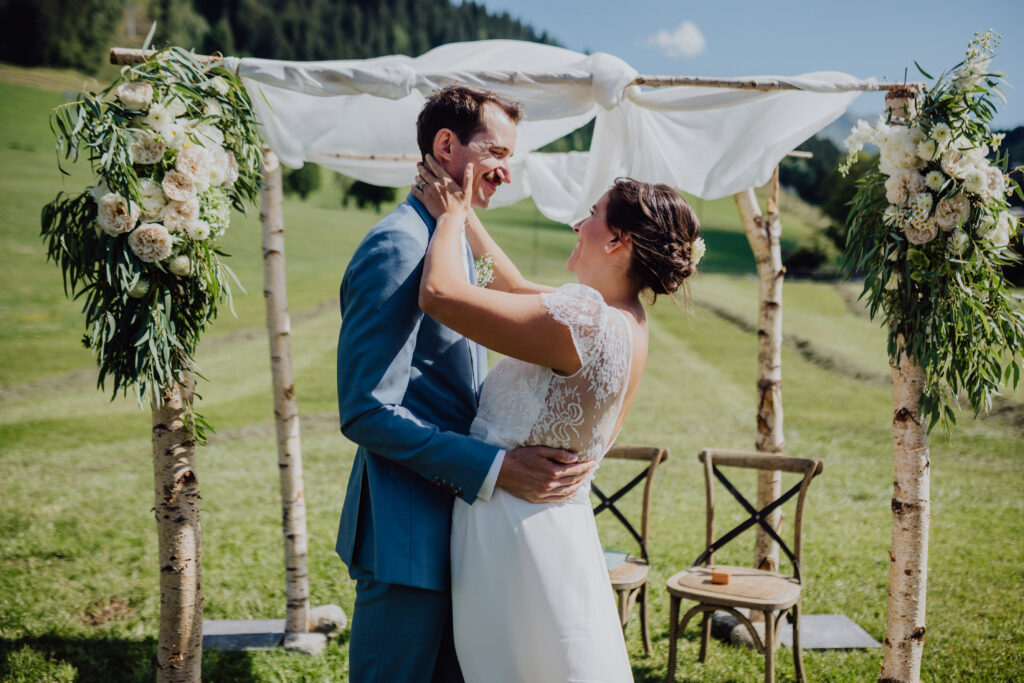
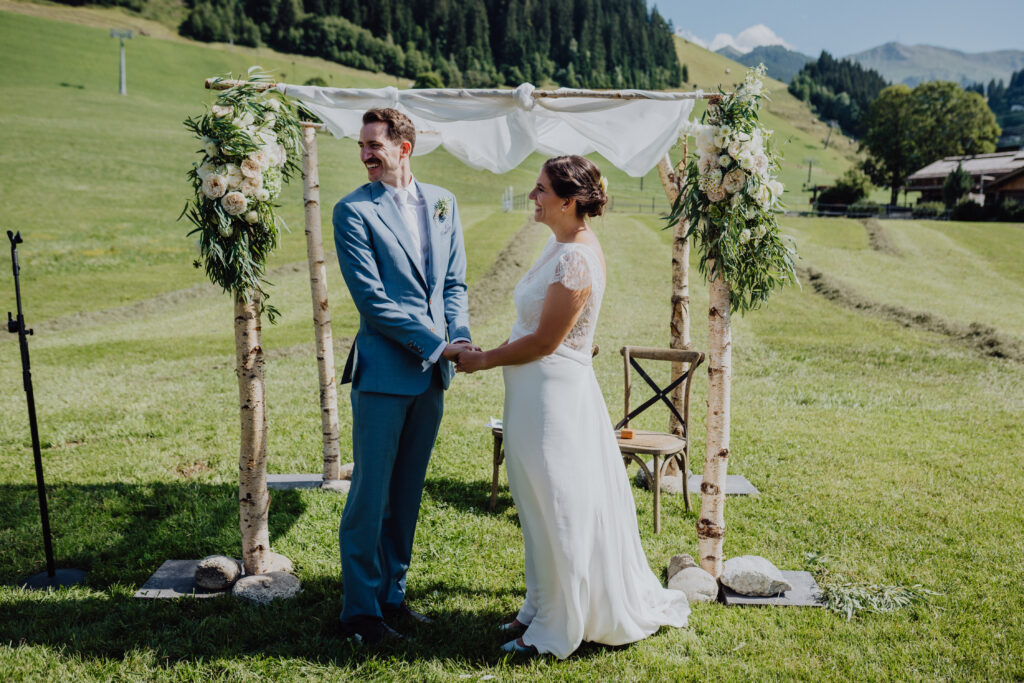
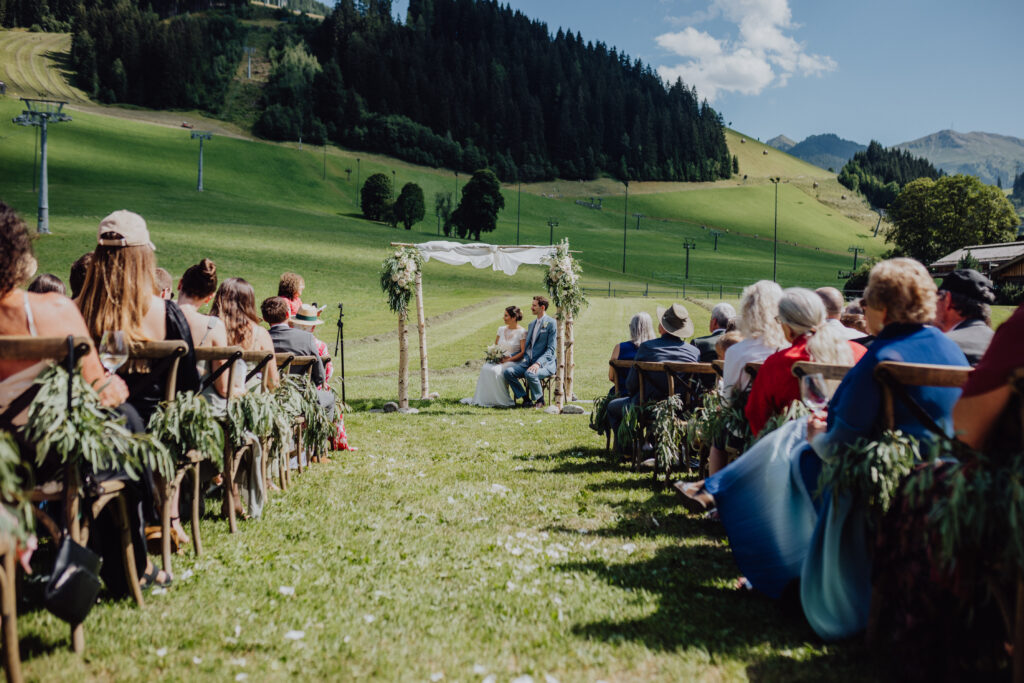
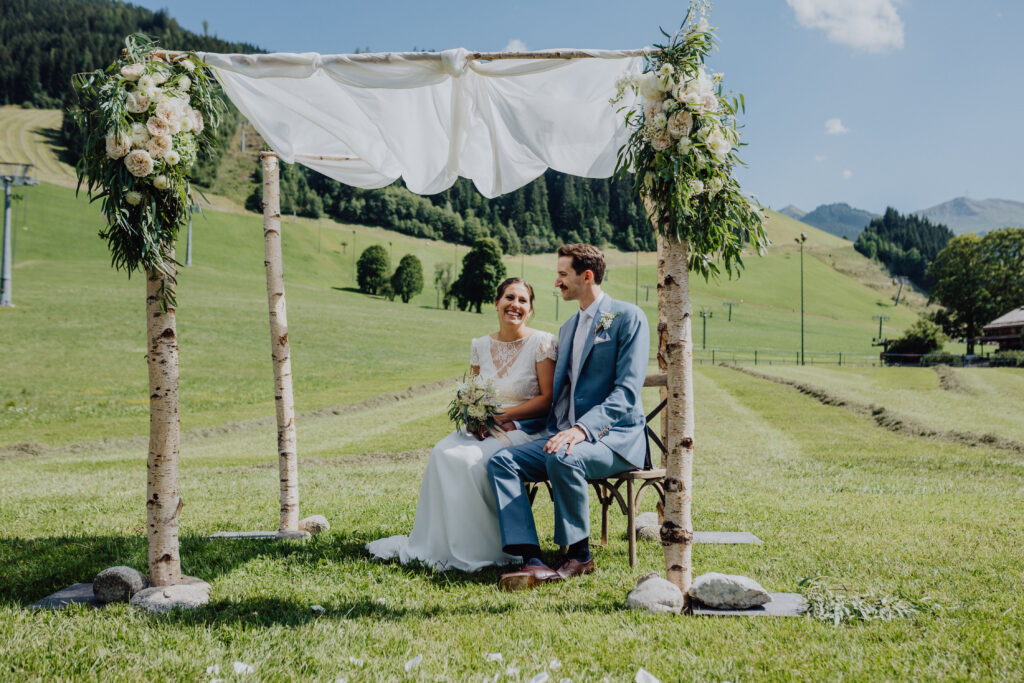
The wedding ceremony began at 3:30 PM on the meadow of the Schwarzachers. The chuppah formed the framework of the ceremony and was covered with fabric at the top, while the sides remained open. Depending on the weather, additional seating under the covered terrace could be used.
Since many guests had traveled from different countries, translation booklets were provided. Guests were also asked to refrain from using cell phones during the ceremony. Sunscreen, fans, and tissues were also available. Such details seem small, but they significantly contribute to the guests' comfort during a longer outdoor wedding ceremony.
The children were also included, among other things as flower children and ring bearers. Friends designed the secular wedding ceremony and led through the ceremony. This created a personal form without an external wedding speaker.
The chuppah and the seven blessings incorporated individual elements of Jewish wedding traditions. Although it was not a Jewish wedding, these components were interpreted personally and adapted to the history of the couple getting married.
For a relative in New York, the ceremony was broadcast live. The 3:30 PM time was chosen deliberately because it was 9:30 AM there. Microphones and the broadcast were therefore tested before the guests arrived.
Reception, dinner and party until three in the morning
Following the ceremony, the reception began around 4:15 PM on the terrace at Schwarzacher. The wedding cake, desserts, initial speeches, and group photos were scheduled for this part of the afternoon. Afterwards, the reception transitioned into an open cocktail hour before the guests moved into the lounge in the early evening.
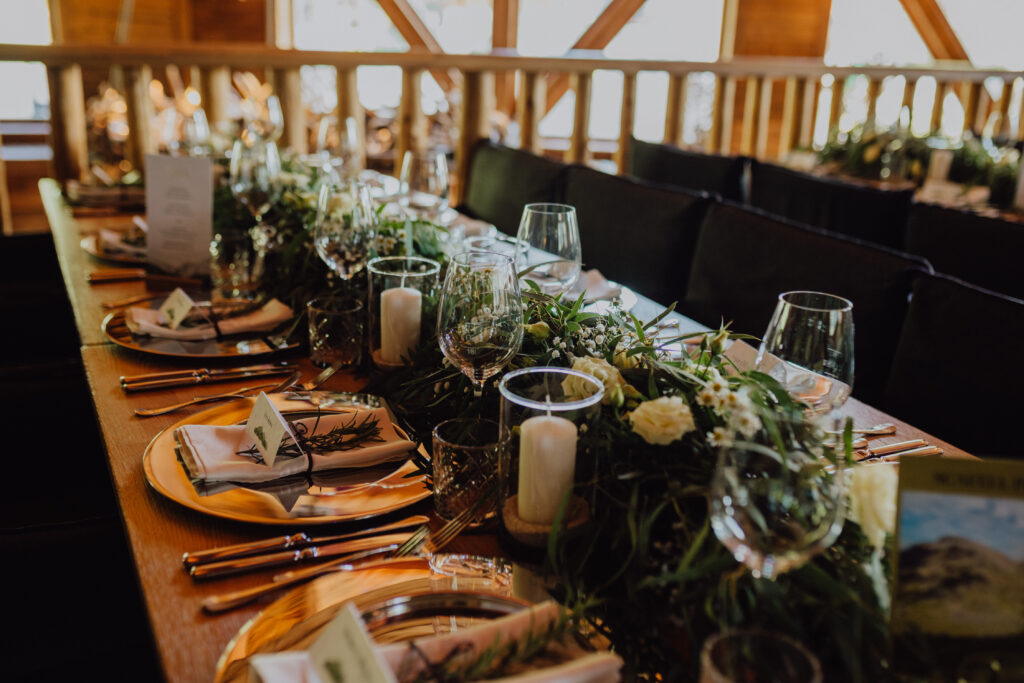
The dinner began at 7 PM. With around 150 guests, a clear transition between the terrace, lounge, and bar area was important. Separate meals and later a small children's disco were planned for the 15 children. In addition, sleeping arrangements were available for younger children. This allowed families to attend the celebration longer without the evening having to be focused entirely on the children.
Following the speeches were the opening dance and an Austrian folk dance. The groom's mother demonstrated basic steps and directly involved the international wedding guests. Afterward, everyone danced a Hora together. This created a seamless transition from the official part to the party.
Around 10 p.m., the party started with a DJ. At midnight, there was Kaiserschmarrn and mini schnitzel rolls as a late-night snack. The celebration at the Schwarzacher went on until three in the morning.
When a bike festival influences wedding planning
During the wedding weekend, a bike festival took place in the region, the dates of which were not yet fixed at the time of booking. Road closures and changed access routes therefore had to be integrated at short notice into the schedule of the Mountain wedding be integrated.
Check road closures and regional events in advance
The closures changed the access routes in the area of the Unterschwarzachhof and the Schwarzachers. Those affected included the bridal couple, guests, deliveries, and the arrivals of photography, floral, bakery, musicians, and other service providers.
With a Destination Wedding in the Salzburg region therefore the regional event calendar should not only be checked at the beginning of planning. Sports events, concerts, and seasonal events can influence hotel availability, minimum stays, prices, public transportation, and access routes.
Since many dates are not yet fixed when booking the location, a renewed coordination with the hotel team, location team, and regional contacts a few months and a few weeks before the wedding is worthwhile. This way, alternative routes, adjusted delivery times, and time buffers can be planned in good time.
How the bride was brought to the Schwarzacher unnoticed
After the first look, the groom drove back to the guests. The bride, on the other hand, was supposed to go to the Schwarzacher arrive. However, due to the road closure, the originally planned access in the area of the Unterschwarzachhof was not usable. Using the regular route, she would have had to drive directly past part of the wedding party.
Therefore, the security personnel of the bike festival were contacted on-site and the situation was explained to them. After a friendly coordination, the vehicle with the bride was allowed to drive through the closed area. What initially seemed like a difficult access ultimately turned into a personal escort all the way to the Schwarzacher.
This allowed the bride to arrive on time without being seen by the guests before the humanist wedding ceremony. An additional time buffer also ensured that the start of the ceremony did not have to be delayed.
Why on-site support is crucial
Unexpected changes on the wedding day should ideally not have to be resolved by the bride and groom themselves. With this international wedding having on-site support was particularly helpful since multiple service providers, around 150 guests, and various access routes had to be coordinated.
As an experienced wedding planner it is important to me to make quick and calm decisions in such moments. This includes assessing the impact on the daily schedule, informing the affected service providers, and implementing a solution without causing additional anxiety for the bride and groom.
Who get married in the mountains wants to, should always keep local conditions in mind. Gondolas, weather, access roads, and parallel events can affect proceedings. On-site support does not replace preparation, but it ensures that last-minute challenges do not fall on the wedding couple or their guests.
Guest management at an international wedding
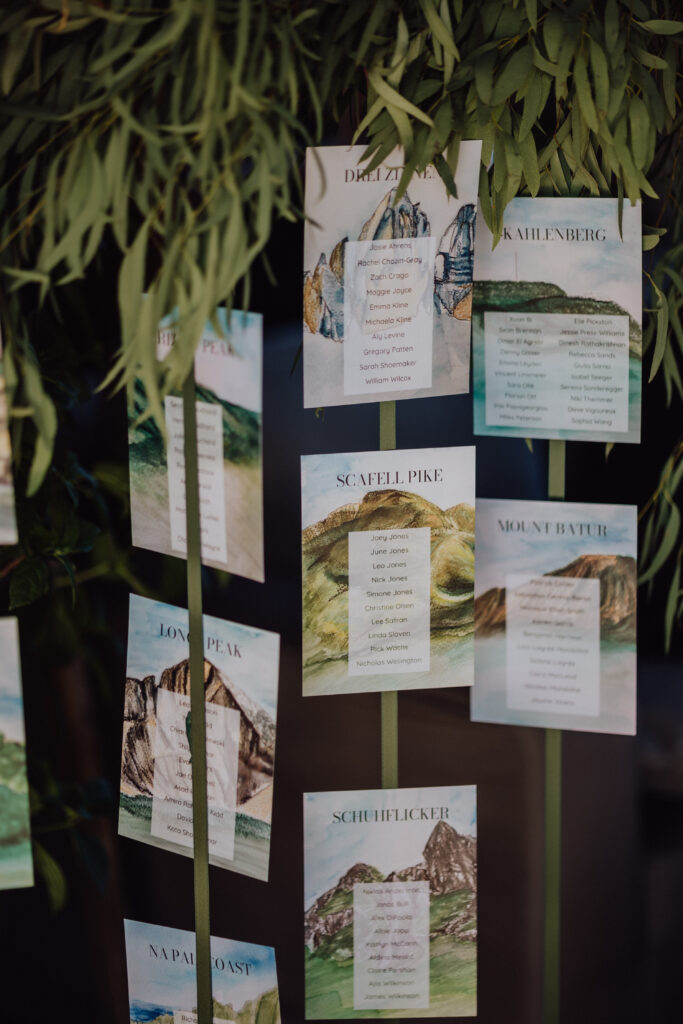
With a international wedding With around 150 guests, clear communication is particularly important. Information regarding travel, the hotel, the wedding venue, transfers, and the schedule was therefore bundled on a wedding website.
Consolidate information about a wedding website
The wedding website was the central hub for the guests. It contained information on how to get there, for the Unterschwarzachhof, regarding the Schwarzacher, the program details, and public transportation in the Salzburg region. Recommendations for free time before and after the wedding have also been provided.
With a large guest list, it is usually not practical to send the same information by email multiple times. Different versions and later additions quickly cause confusion. A central page is easier to update and reduces follow-up questions.
Also Stationery and digital communication should match in content. Invitations, wedding websites, and subsequent messages must contain the same times, addresses, and contact persons. If the hotel and the wedding venue are not identical, it should be especially clear where each part of the program takes place.
Do not request guest data too early
Flight numbers, arrival times, and room preferences should only be requested once most guests have actually booked their travel. If such information is collected too early, it often changes and has to be checked again later.
With this Destination Wedding in Austria international flight connections, train journeys, baby cots, dietary requirements, and individual arrival times were relevant. However, not every piece of information was needed 16 months before the wedding.
Initially, binding confirmations or cancellations and basic room requests for the Unterschwarzachhof were sufficient. Specific travel dates followed later. This phased timeline kept communication clear and prevented guests from having to provide the same information multiple times.
Final guest check-in eight weeks prior
About eight weeks before the Mountain wedding a final guest check-in took place. At this time, current flight numbers, train connections, arrival and departure dates, cots, room occupancy, allergies, and dietary requirements were requested.
Only with this current information can transfers, check-in times, and individual processes be reliably planned. The hotel team, location team, and catering team also need reliable figures in good time.
The form should be clearly structured and contain only information that is actually needed. With around 150 people, a standardized query also helps to pass on data in a structured manner to the hotel, wedding venue, and other service providers.
Set clear deadlines and explain them clearly
Deadlines are met more effectively when guests know why their feedback is needed. Instead of just stating a date, it should be briefly explained that rooms, transfers, dietary requirements, or participant numbers must be finalized and reported after that point.
At an international wedding, inquiries across different countries and time zones often take more time. Deadlines should therefore be chosen realistically and communicated clearly. On the other hand, multiple reminders at short intervals are usually not helpful.
Based on my many years of experience in wedding planning it turns out that well-founded deadlines are taken more seriously. At the same time, it should be clear who collects feedback and follows up on missing information. This way, the couple getting married does not have to chase after every response themselves.
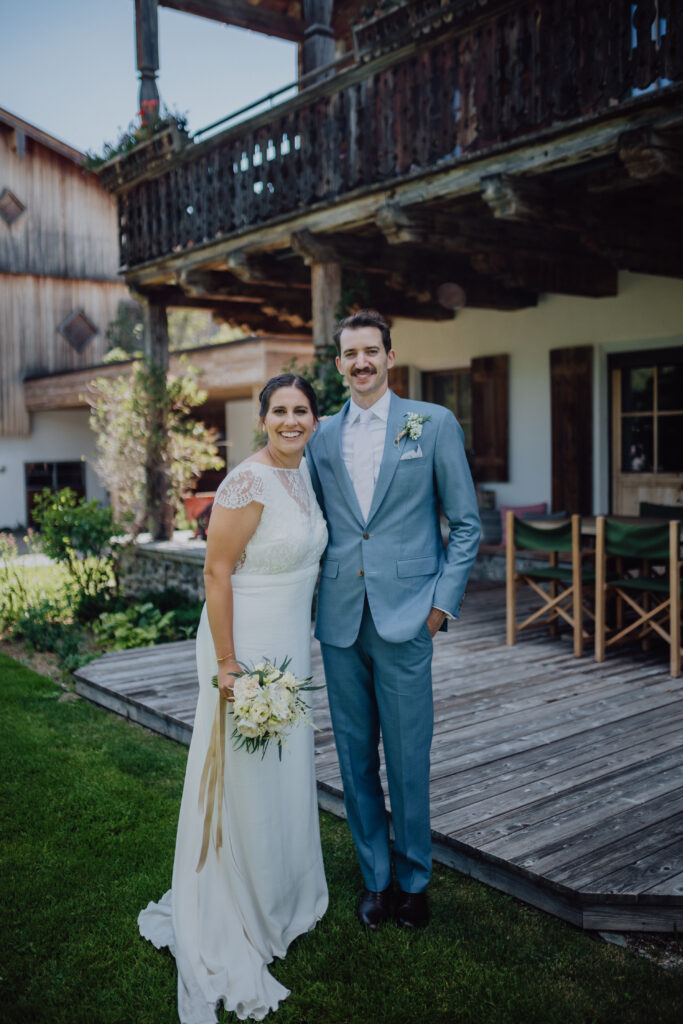
After-Wedding Event at Genuss Hoch 12
After a long wedding night, Sunday was supposed to start quietly. At the same time, it was important to the newly married couple to spend some more time with the guests who had traveled from afar. Therefore, the destination wedding did not end right after the celebration at the Schwarzacher.
Joint conclusion of the mountain wedding at the mountain station
After breakfast at the Unterschwarzachhof, the guests initially had time to start the day in a relaxed manner. Around noon, they took the gondola up to the Pleasure to the Power of 12. The after-wedding event took place there from 12 PM to 4 PM.
The procedure was less formal than on the previous days. There were no long speeches or fixed program items. Conversations, eating together, and spending time with one another were the focus. After a celebration until three in the morning, this quieter format was fitting.
Those who want to get married in the mountains can use such a conclusion to involve the region once again. Important factors are a realistic start time, clear information about the gondola ride, and a schedule that also works for older guests and families.
After-wedding event with 125 guests and 14 children
On Sunday, around 125 guests and 14 children attended. Drinks, finger food, vegetable platters, and Kaiserschmarrn as a dessert were offered. The food was deliberately chosen to be uncomplicated and suited a casual afternoon on the mountain.
Even at an informal event, the catering and venue team must be informed in advance about the number of guests, children, dietary requirements, and schedule. For more than a hundred people, sufficient seating and a reliable supply of beverages are required.
The open format was also helpful for the children. They didn't have to take part in another long, formal sit-down meal. This created a shared conclusion that suited the size of the party without feeling like a second wedding celebration.
Why an extra day is worth it for an international wedding
With a international wedding many guests travel for several hours or from another continent. An additional shared day creates more time for conversations, which often fall short on the wedding day.
An after-wedding event does not have to be planned big or formally. The crucial thing is that it fits the guests' travel itinerary and the region. At this Mountain wedding Was the afternoon at the mountain station a sensible addition, since many guests were staying on-site until Sunday or Monday anyway?.
Participation should remain voluntary. Some guests need rest after the celebration or have to leave early. If the agenda item is clearly communicated as a casual ending, no additional pressure is created.
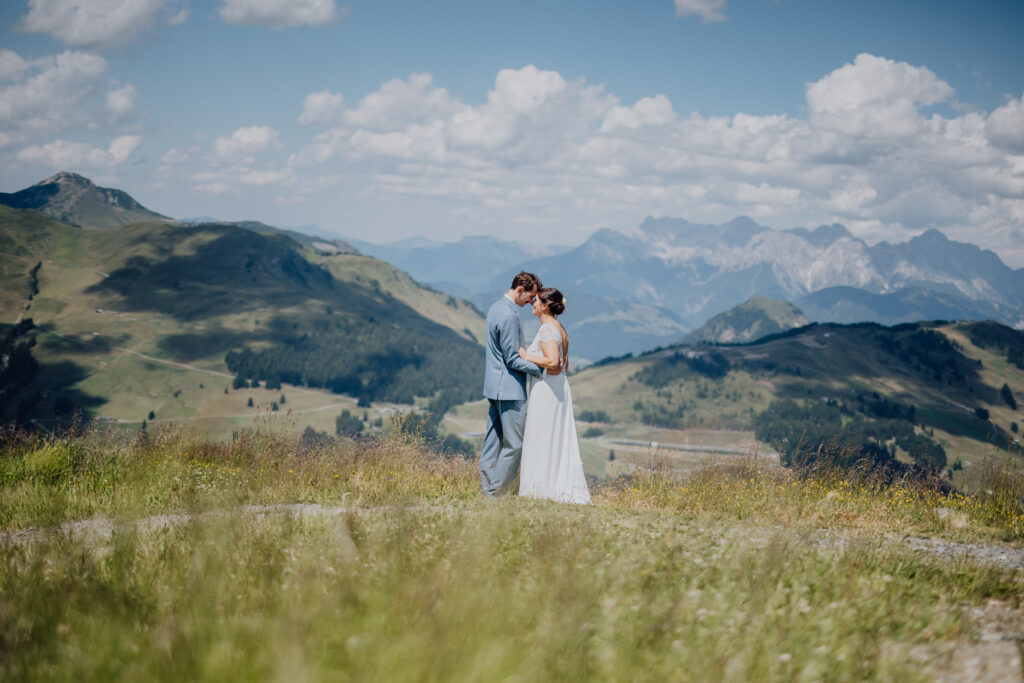
Real Wedding in Salzburg: What couples should consider for a large mountain wedding
This Real Wedding shows that a wedding with around 150 guests in the mountains is very feasible. The deciding factor is less the sheer number of guests than the Interaction between wedding venue, hotel, travel arrangements, and schedule.
Check wedding venue, hotel, and accessibility together
A big Mountain wedding needs plenty of space for the ceremony, dinner, and party. Equally important are enough rooms, short distances, and good accessibility for guests without a car of their own. At this wedding, the Schwarzacher provided the event areas, while the Unterschwarzachhof served as the hotel and location for the get-together.
When making the selection, breakfast times, check-in procedures, delivery options, and the capacities of the hotel and venue team should also be taken into consideration. With 150 guests, such details significantly impact the entire schedule.
Consider international guests from the start
International guests need clear information about airports, train connections, accommodations, and itinerary items. A wedding website helps provide all important details in one place. However, binding travel dates should only be requested once flights and train connections have actually been booked.
A casual get-together on Friday and a voluntary wrap-up on Sunday also provide more flexibility for long travel times or delays.
Plan events, time buffers, and alternatives
Sporting events, festivals, or seasonal occurrences can impact roads, hotels, and public transportation. The regional event calendar should therefore be checked multiple times during planning.
Gondola schedules, road closures, and alternative access routes are also part of the preparation for a Destination Wedding in the Salzburg region. At the same time, a clear daily schedule requires realistic time buffers. Flexible planning does not mean giving up fixed routines, but rather knowing potential alternatives and being able to react calmly to changes.
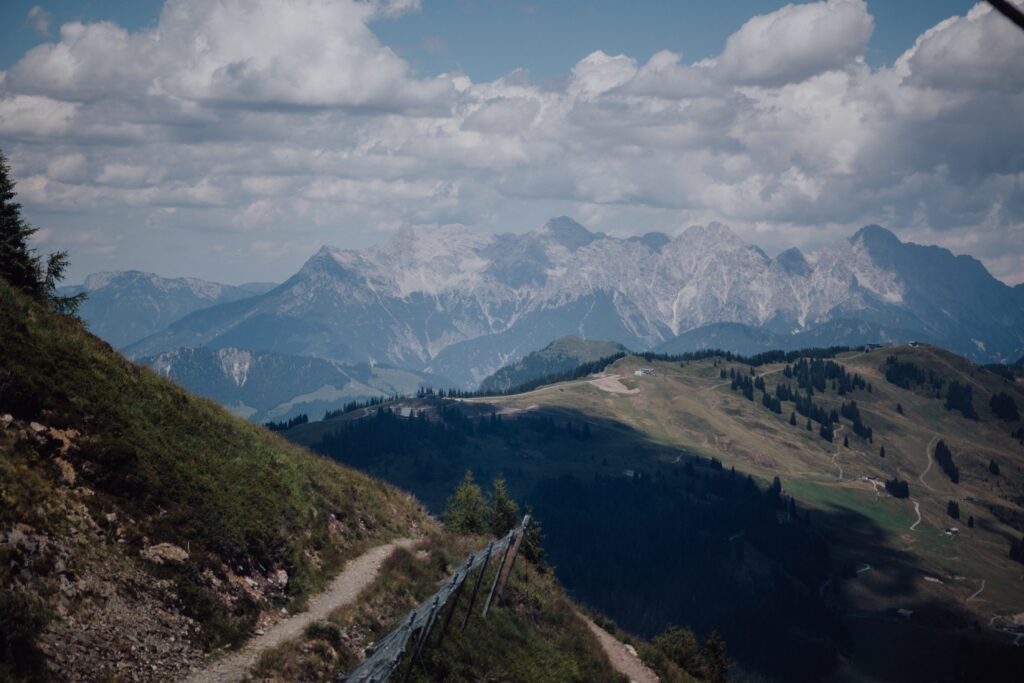
Conclusion: Planning a destination wedding in the Salzburg region with 150 guests
This Real Wedding shows that a large Mountain wedding does not have to fail due to the number of guests. The key is to consider the wedding venue, hotel, travel arrangements, and program together from the very beginning. The Schwarzacher provided the fitting setting for the symbolic wedding ceremony, dinner, and celebration, while the Unterschwarzachhof was used as an exclusively booked hotel and the location for the get-together.
Equally important were the wedding website, a late guest check-in, and clear deadlines. The bike festival additionally showed that even with a long planning period, not every development is predictable. Reliable contact persons and realistic time buffers then help to absorb short-term changes.
He who with many guests get married in the mountains should therefore not ask first whether the desired size is possible. More important is which region, which wedding venue, and which hotel offer the necessary requirements and how the individual days can be meaningfully combined.
A Free consultation offers the opportunity to discuss initial ideas, guest count, and potential locations for a Destination Wedding in Austria to classify together and examine at an early stage which planning steps are truly necessary.
Your Ronja
Photos: Alexandra Gröbner