

Why I am writing this article – and what you will really learn here
I am planning as Wedding planner international weddings in the Alps for years. Guests from America, from Europe, from countries where nobody knows how cold it gets at 1,800 meters in December. I've coordinated shuttles, requested flight data, negotiated hotels with minimum stays, and managed guests who handle their RSVPs differently than German couples are used to.
This article is not a theoretical summary. Here you will get concrete work steps, Cost items and Decisions, that you have to make when planning a destination wedding in the Alps before your guests even book their flights.
Travel for your destination wedding in the Alps: airports, transfers, and shuttle planning
Which airports are suitable for which guests
For most international guests are Munich and Zurich the main airports. From there, there are sometimes good train connections towards the Alps, but only sometimes. The subsequent journey to the respective region can take several hours.
In addition, smaller airports such as Salzburg, Innsbruck, or Bolzano are options. Especially for guests from other European countries, there are sometimes direct flights to Salzburg or Innsbruck, or to other smaller airports. Depending on your starting point, it may also make sense to fly to Munich or Zurich first and book a connecting flight to Salzburg, Innsbruck, or Bolzano from there.
Which connection fits best should be checked individually, since not all guests are arriving from the same city or the same country.
Planning shuttles: Costs, child seats, and why you need your flight details early
Shuttles are a Cost factor that many couples underestimate. A single vehicle from Munich to the Alps can cost 500 to 600 euros. If you have 30 guests arriving at different times, that quickly gets expensive. That's why you need to decide early on: Does the bridal couple cover the costs or do the guests pay themselves?
Even if the guests pay, the coordination often goes through you or the wedding planner. For that, you need the flight details – and specifically: Flight numbers, arrival times, departure times. Families with children must state the ages of the children so that it can be determined whether child safety seats are needed.
Based on the arrival times, you can decide which guests can share a vehicle. If a larger group is arriving on the same flight, a charter bus might make more sense than several individual vehicles. That saves costs and reduces the number of transfers. But that only works if you have the data early enough, not two weeks before the wedding.
Compared to the US, venue costs in the Alps can be lower, but transfers in particular can represent a significant cost factor.
Hotels, minimum stays, and why winter turns your planning upside down
Hotels in the Alps have Winter without minimum stays. Depending on the month six to seven nights common. If your wedding takes place in December or January, you have to factor that in—and not just for yourself, but for your guests as well.
This means: You need to contact hotels early. You need to inform your guests about the accommodation situation early on. You need to provide various hotel recommendations that cater to different budgets and varying lengths of stay.
Hotel planning is directly related to the Shuttle planning together. To coordinate the transfers, you need to know where the individual guests are staying. If five guests are sleeping in different hotels in different districts, you need more shuttles than if everyone is in the same hotel.
Outside of the holiday seasons, the situation is more relaxed. Minimum stays are less extreme, hotels have better availability, and flight prices can be lower. That is why you should check the German, Austrian, and Italian holiday periods before setting a date.
Guest management for a destination wedding in the Alps
The Guest management at a destination wedding, is the biggest challenge. How are they arriving, how are they departing, what information do they need, when will they get back to you, who is coming to the after-wedding event?
Guests from different nations handle feedback differently. Not everyone replies within three days. Not everyone reads emails completely. That is why you must communicate clear deadlines – and you must follow up when information is missing.
In addition, you must inform the guests about the conditions on-site. What is the weather like? How cold does it get on the mountain? What should they pack? Guests from regions where it is 20 degrees in December do not know that they will need a jacket at an altitude of 1,800 meters even in summer.
The check-in form: Ask everything at once instead of asking five times
A typical mistake is repeatedly asking for individual pieces of information throughout the entire planning process. I have experienced couples who asked their guests four or five times whether they were coming or not because the inquiry was started too early.
From my experience as Wedding planner has it proven effective to first use the save-the-date to check who will generally be coming to the wedding and who will not.
This form asks for everything you need:
- Flight number and arrival time
- Is a shuttle needed?
- Age of the children (if any)
- Does a child need a high chair or a travel cot?
- Which wedding weekend events are the guests attending?
- Participation in the get-together or after-wedding event?
- Menu selection (if required)
You do this once. Not spread out over five or six different emails. A single, well-structured form will save you weeks of follow-up questions.
Especially at international weddings, an additional Wedding website be more useful than a traditional invitation card. There, you can bundle accommodation recommendations, link the check-in form, and show your guests activities for the days before and after the wedding. Options for onward travel to other European countries can also be shared there.
This is especially helpful for guests who may never have been to Europe or the Alps and accordingly need a lot of information about the trip and their stay. On a wedding website, you can gather all this information clearly in one place; on a traditional invitation card, that would quickly exceed the limit.
Destination Wedding Weekend Instead of a Single Day: Why Multiple Days Are Worth It – And How to Fill Them
If your guests are traveling for a destination wedding in the Alps from America or other European countries and will be staying on-site for several days anyway, it makes sense to plan more than just a single wedding day.
The guests experience not only the wedding, but also the surroundings. They spend more time together. And you can have the wedding take place during the week – when locations and service providers such as a Wedding celebrant or wedding musician are more readily available and prices can sometimes be more attractive. During the week it is quieter, the traffic situation is more relaxed, and you avoid the typical Friday afternoon traffic jams when weekend vacationers are heading toward Austria.
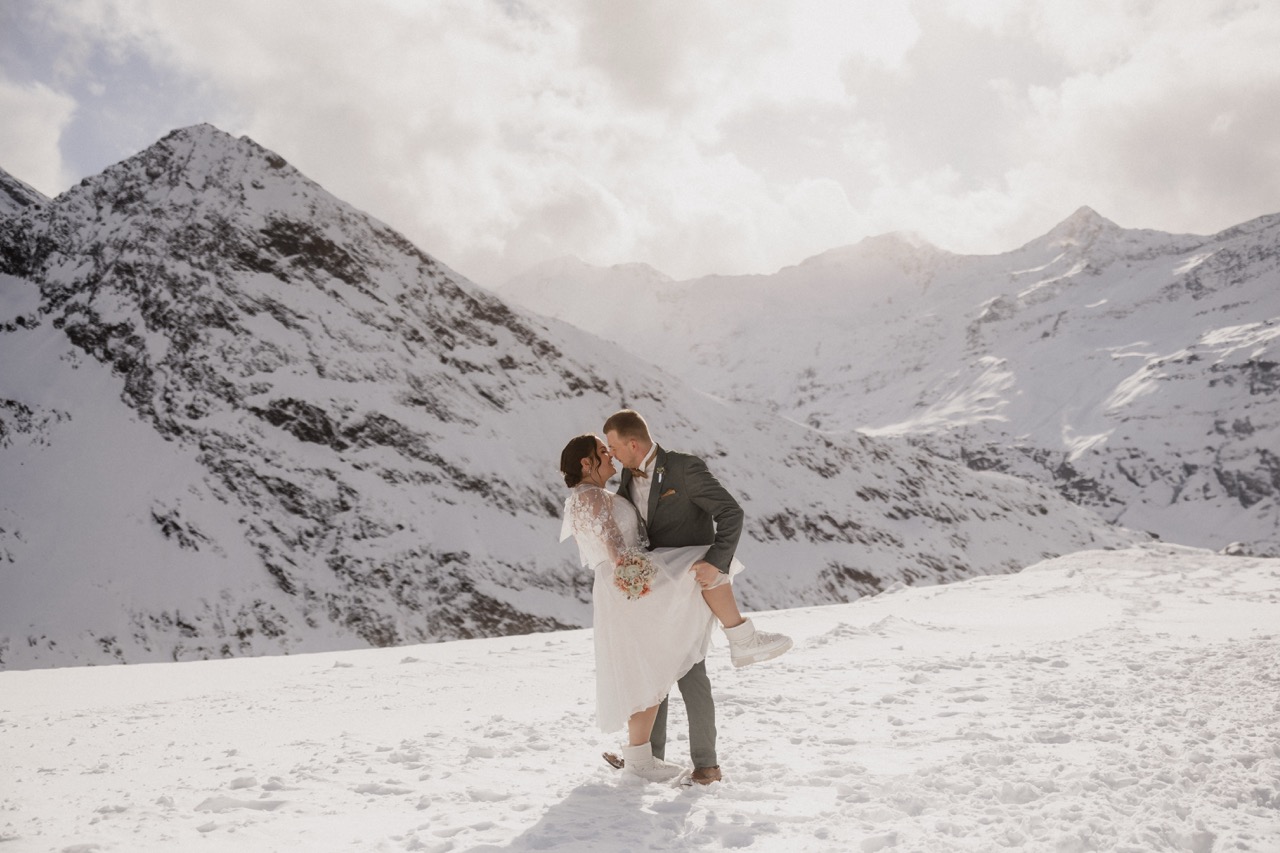
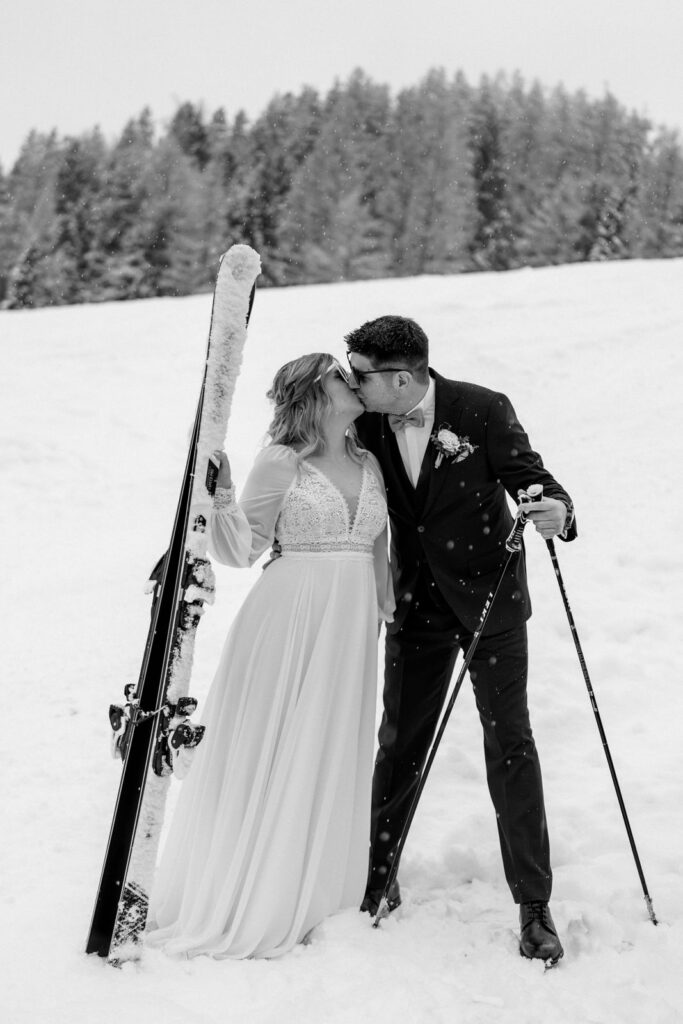
Around the actual wedding day, you can plan additional events and joint activities. With Winter weddings the wedding is often combined with a ski vacation: one day during the trip is the wedding day, and skiing takes place before and after. In addition to skiing, tobogganing, snowshoeing, guided hikes, wine tastings, or helicopter flights are also possible.
Classic planning mistakes for international weddings in the Alps
The most common mistake: a schedule that is too tight. Plan no buffer, assume everything goes according to plan, and then be surprised when a shuttle gets stuck in traffic or a flight is delayed.
Another mistake: not factoring in logistics early enough. Already when searching for a location, you should check how good the English skills are on-site. Not every location in the mountains has staff that speaks fluent English. If your guests do not speak German, this can become a problem.
The Payment methods should be taken into consideration. Not all locations in the Alps accept American Express or credit cards in general. American guests in particular frequently use an Amex; if the hotel does not accept credit card payments, they have to bring cash.
The most important questions before planning – and my answers from practice
Who covers the costs for the shuttles?
You as the bridal couple decide that yourselves. If you cover the transfers, you should budget for this early on. If the guests pay for their own shuttles, coordination can still be handled by you or your wedding planner.
When do I check the flight data?
Ideally about eight to twelve weeks before the wedding via a bundled check-in form. By this time, most guests have already booked their flights and accommodations.
How do I communicate minimum stays and accommodation options to guests?
As early and clearly as possible. A wedding website is particularly well-suited for this because you can centrally provide various accommodation recommendations and important information about the stay there.
Is a destination wedding weekend worth it?
Especially when your guests are traveling from further away and staying in the region for several days, it is a good idea to plan additional events or activities together around the wedding day.
How do I avoid too many emails and missing feedback?
Communicate clear deadlines and bundle the important requests. A comprehensive check-in form is clearer than many individual emails throughout the entire planning process.
What payment methods should I check for hotels and venues?
Check early on whether credit card payment is possible. For many American guests, it may also be relevant whether American Express is accepted.
My conclusion: A destination wedding in the Alps is not a walk in the park – but it is manageable.
A destination wedding in the Alps brings some special planning topics with it. Especially guest management, arrival and departure, shuttle planning, and the coordination of accommodations can quickly become complex. Those who plan early, collect the necessary information in a centralized way, and clearly inform their guests about procedures, deadlines, and local conditions create a good foundation for this.
Especially with international weddings, logistics are one of the biggest challenges. At the same time, a wedding in the Alps offers the opportunity to turn the actual wedding day into several days spent together and to show guests the region with all its possibilities.
If you are thinking of celebrating your destination wedding in the Alps, professional wedding planning can help you keep track of the many organizational details right from the start.
In a free and non-binding consultation can we look together at what you want for your wedding, what kind of support would be useful for you, and what your destination wedding in the Alps could look like.
Your Ronja
Photographers: Pretty Pine Moments, Nicaela Emily